Common Firefighter Exam Study Guide exam mistakes
Preparing for a career in the fire service requires more than just physical fitness; it demands a strategic approach to written testing. Many qualified candidates fail to secure a position simply because they fall into predictable traps during their preparation process.
Underestimating Transversal Skills
Many candidates focus exclusively on fire-specific knowledge like fire behavior or suppression tactics while ignoring transversal tests. These sections, which include mechanical aptitude, spatial awareness, and basic mathematics, are often the primary filters used to narrow down large applicant pools. Neglecting these core competencies can lead to a lower ranking, regardless of how well you know department regulations or building construction.
Poor Time Management Strategies
The firefighter exam is designed to be challenging under pressure, and poor time management is a leading cause of failure. Candidates often spend too much time on difficult questions, leaving them unable to complete the rest of the exam. Developing a strategy to skip and return to complex problems is essential for maximizing your score across all sections.
Neglecting Situational Judgment and Soft Skills
A common mistake is treating situational judgment questions as purely academic. These questions assess your ability to prioritize tasks and make ethical decisions under stress. Failing to understand the core values of fire service organization and administration often leads candidates to choose answers that are technically correct but operationally inappropriate for a professional firefighter.
Overlooking Physical and Oral Preparation
The recruitment process is holistic, and focusing solely on the written exam is a critical error. Candidates who neglect their physical conditioning or fail to prepare for the oral board interview often struggle even if they pass the written portion. Balance your study time with physical training to ensure you are ready for every stage of the hiring process.
Inconsistent Study Habits
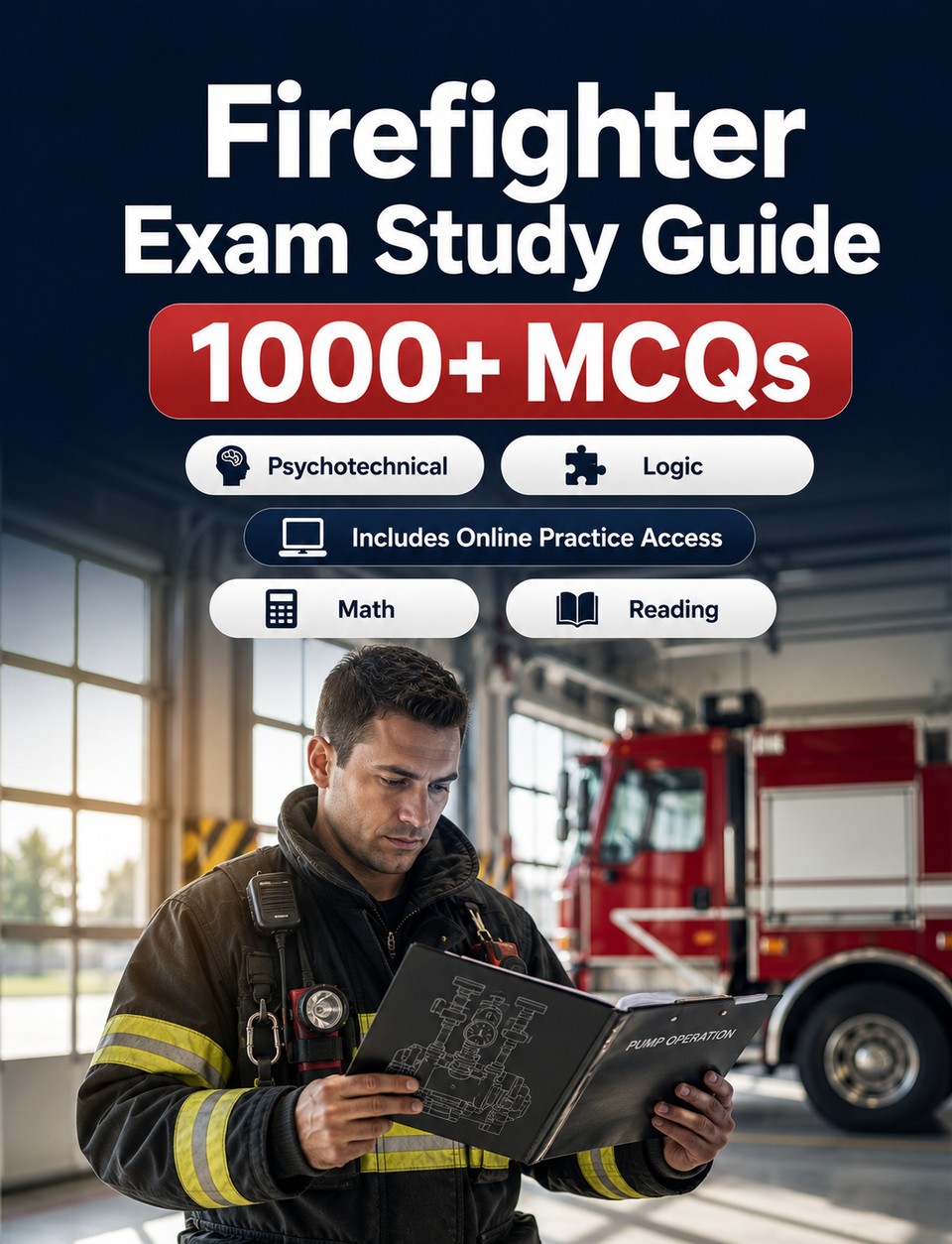
Cramming in the days before the exam is ineffective for retaining complex information regarding hazardous materials, EMS fundamentals, or incident command protocols. Our Firefighter Exam Study Guide encourages consistent practice, and for your convenience, the printed book includes a QR code inside that grants you access to additional online practice resources to track your progress.
FAQ
- Is the firefighter exam mostly about fire science?
- No, while fire science is important, a significant portion of the exam tests aptitude, logic, and general knowledge.
- How can I improve my mechanical aptitude score?
- Consistent practice with diagrams and mechanical reasoning questions is the most effective way to improve this specific skill set.
- What is the best way to handle situational judgment questions?
- Always prioritize safety, team coordination, and department policy when evaluating the scenarios presented in these questions.
- Should I study for the physical test at the same time as the written exam?
- Yes, maintaining a balanced schedule ensures you are prepared for both the academic and physical demands of the fire academy.