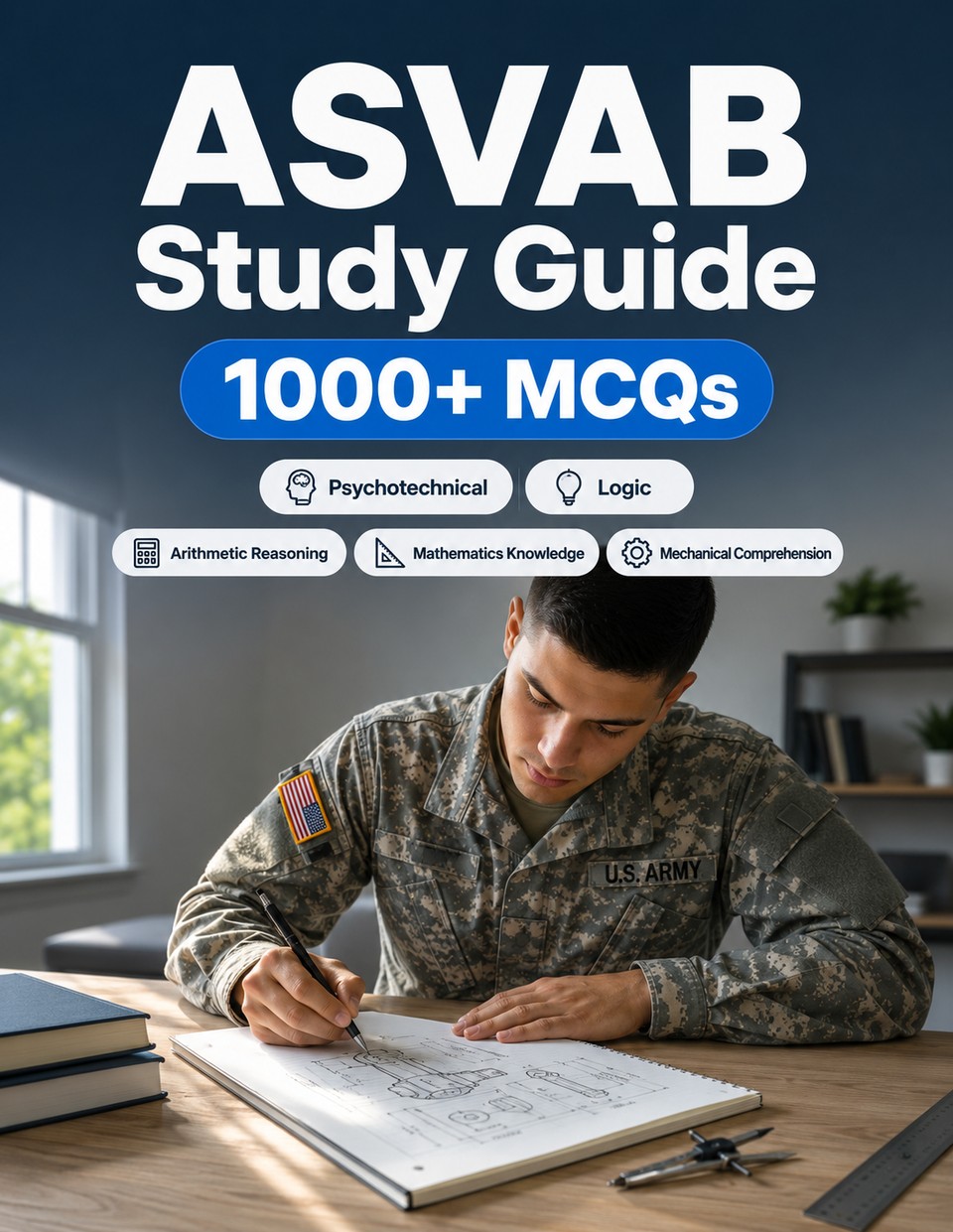
How to pass the ASVAB Study Guide exam
Passing the ASVAB is the critical first step toward securing your future in the U.S. military. With a structured approach and consistent practice, you can master the diverse subjects required to achieve a competitive score.
Create a Structured Study Timeline
Success on the ASVAB requires a commitment of at least 6 to 8 weeks of dedicated preparation. Aim to study for 60 to 90 minutes each day to maintain momentum without burning out. Consistency is far more effective than sporadic, long-duration study sessions.
Begin by taking a full-length diagnostic test to identify your baseline score. Use this data to map out your study calendar, allocating more time to the subjects where you scored the lowest. Our printed prep book is an essential tool in this process, providing a comprehensive curriculum and including a QR code for online practice access to help you track your progress.
Prioritize High-Weight Subjects
The ASVAB covers a wide range of topics, but not all sections carry the same weight for your Armed Forces Qualification Test score. Focus your primary energy on Arithmetic Reasoning, Mathematics Knowledge, Word Knowledge, and Paragraph Comprehension.
Mastering these core areas provides the foundation for the entire exam. Once you are confident in your mathematical and verbal abilities, shift your focus to the science and technical sections, such as General Science and Mechanical Comprehension, to round out your knowledge base.
Target Your Weak Spots
Do not waste time reviewing topics you have already mastered. Instead, use a systematic approach to break down complex subjects like algebraic equations, geometry, and biological principles. If you struggle with fractions or ratios, dedicate specific days to drilling those concepts until they become second nature.
Use active recall methods rather than passive reading. Write down formulas, create flashcards for vocabulary root words, and solve practice problems until you can complete them accurately under time constraints.
Mastering the Math and Science Syllabus
The mathematics portion requires proficiency in operations with integers, decimals, and percentages. Practice solving word problems that involve interest calculations and proportions, as these are common on the exam. For the science sections, focus on understanding Earth and space systems, as well as basic chemistry and physical properties.
When studying human anatomy and biological principles, focus on the big picture rather than memorizing every minute detail. Use diagrams to visualize spatial reasoning problems, which will help you navigate the geometry section more effectively.
Simulate Test Conditions
The final phase of your preparation should involve taking full-length mock exams under timed conditions. This builds the mental stamina required to stay focused during the actual test. It also helps you get comfortable with the pacing of each subtest.
Review every incorrect answer after each practice test. Understand not just the right answer, but why your chosen answer was wrong. This analysis is the most effective way to prevent repeat mistakes on the official exam day.
FAQ
- How many hours a day should I study for the ASVAB?
- We recommend 60 to 90 minutes of focused study per day, five to six days a week, to build retention and confidence.
- Which sections are most important for my score?
- Arithmetic Reasoning, Mathematics Knowledge, Word Knowledge, and Paragraph Comprehension are the primary drivers of your AFQT score.
- How can I improve my math score if I am not good at algebra?
- Break down algebraic expressions into smaller steps and practice basic operations daily. Consistent repetition is the best way to overcome math anxiety.
- Are practice tests necessary for passing?
- Yes, practice tests are essential for identifying your weak spots and improving your speed and accuracy under timed conditions.
- Does the study guide include online resources?
- Yes, our printed prep book includes a QR code that grants you access to extensive online practice materials and additional test-taking tools.